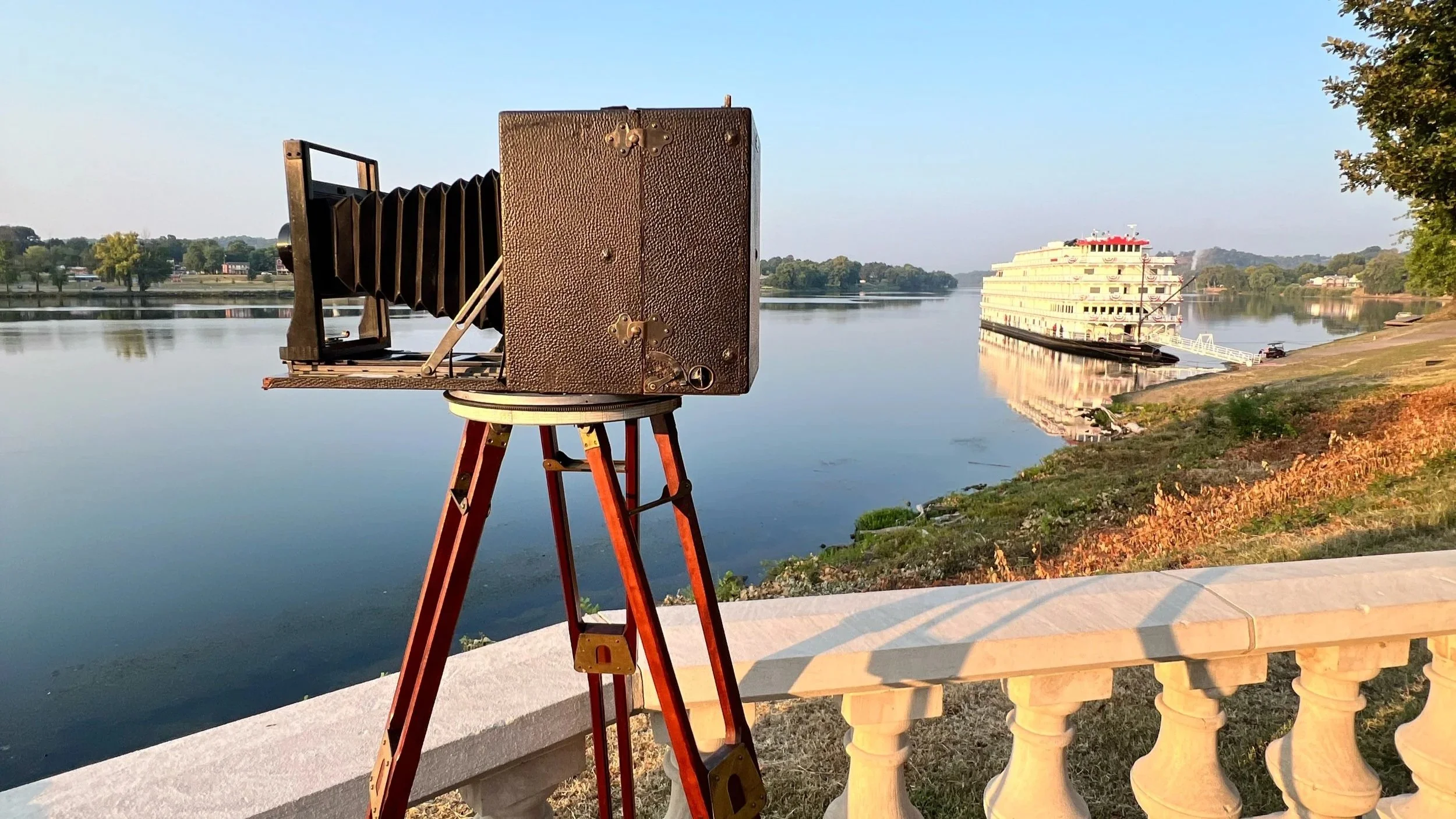
The Cirkut Camera
How it works and why it still matters
There are easier ways to make a panoramic photograph.
Today, a phone can sweep across a scene and assemble a panorama almost instantly. A digital camera can make a series of overlapping photographs that software stitches together with remarkable precision. In the early 20th century, the Cirkut camera presented another solution: rotate the entire camera while simultaneously moving a long roll of film through it.
A Cirkut doesn't simply take a very wide photograph. During an exposure, the entire camera slowly revolves on a geared tripod head while a spring-powered motor pulls film past a narrow vertical slit. The movement of the film and the rotation of the camera are synchronized. When everything works correctly, the camera essentially paints the scene across the film as light passes through the exposure slit.
The result can be a negative several feet long. With the right lens and enough film, a complete 360-degree photograph is possible.
More than 100 years after my own 1921 No. 10 Cirkut camera was built, I still use it to make photographs this way.
The origins of the Cirkut camera
The Cirkut emerged during an era of considerable experimentation with panoramic photography. Rotating panoramic cameras existed well before it, but the system that became the Cirkut was developed in the American West and refined into a commercial product in Rochester, New York.
William J. Johnston of Rock Springs, Wyoming, received a patent for a Cirkut-type panoramic camera on November 29, 1904. Johnston followed it in January 1905 with a patent for an improved revolving mechanism. David A. Reavill, also associated with Rock Springs and later Rochester, patented additional panoramic-camera mechanisms.
Johnston and Reavill assigned their designs to the Rochester Panoramic Camera Company, which had actually been incorporated in Wyoming in May 1904.
The camera that eventually went into commercial production, however, owed much to Rochester inventor Frederick Brehm. Brehm patented his panoramic-camera design in January 1905, and it became the basis of the first commercially manufactured No. 10 Cirkut.
The Rochester Panoramic Camera Company’s life was brief. In July 1905 its property and trademarks passed to the Century Camera Company of Rochester. Century was already controlled by Eastman Kodak, and in 1907 it became the Century Division of Eastman Kodak.
From there, the Cirkut passed through a succession of familiar names in American camera manufacturing: Century Camera, Eastman Kodak's Century and Folmer & Schwing operations, and eventually the independent Folmer Graflex Corporation.
The spelling “Cirkut” was intentional. David Reavill applied for the Cirkut trademark in 1905, and it was registered in 1906. Cirkut historian Bill McBride wrote that “Circuit” was already registered, leading the inventors to adopt the distinctive spelling that has identified the camera ever since.
The lens remains open during this process. Instead of a conventional shutter opening for a fraction of a second, the Cirkut exposes only the narrow strip of film positioned behind the vertical slit.
As the camera turns, the film moves in the opposite direction.
The geometry is arranged so that the image projected by the moving camera and the film passing behind the slit travel at corresponding rates. For the tiny portion of the image being recorded at any instant, the film is effectively stationary relative to the projected image.
Then the camera moves on and records the next narrow slice of the scene.
And the next.
And the next.
Over the course of an exposure, those slices become one continuous negative.
In a sense, it is essentially an analog scanner built from wood, brass, leather, gears and springs.
Gears, lenses and the strange geometry of a Cirkut
Making all of this work requires more than simply turning the camera at approximately the right speed.
The rate at which film travels through the camera has to correspond to the focal length of the lens and the camera's rotation. If that relationship is wrong, the image becomes compressed or stretched horizontally.
Cirkut cameras therefore came with sets of interchangeable brass pinion gears.
The photographer selected a gear appropriate to the lens and focusing distance. That gear determines the relationship between film movement and camera rotation.
This is one of the things that makes operating a Cirkut so different from using an ordinary large-format camera. Changing lenses isn't simply an optical decision. Lens focal length changes the length of the panorama itself, as it becomes part of the mechanical operation of the camera.
Exposure works differently, too.
Later Cirkuts use a variable-speed governor to control the clockwork mechanism. What we would normally call “shutter speed” is really determined by how quickly the film passes the exposure slit. Typical exposures are fractions of a second, but that fraction is occurring continuously as the camera scans across the scene.
Early Cirkut cameras approached the problem differently. Instead of the later governor, they used interchangeable air-resistance fans to regulate the speed of the camera.
The Cirkut camera models
Cirkut describes a family of cameras rather than one particular model.
The number generally corresponds to the width of film the camera was designed to use. Over the years there were Cirkut cameras or outfits designated No. 5, No. 6, No. 8, No. 10 and No. 16.
The No. 6 and No. 8 were generally sold as Cirkut Outfits. Their panoramic film magazine could be attached to a conventional R.B. Cycle Graphic view camera, allowing the camera to serve double duty for both conventional and panoramic work.
Other models, including the No. 10, were purpose-built panoramic cameras.
The largest, the No. 16, used film approximately 16 inches wide. At the other end of the range, the compact No. 5 was introduced in 1915 and used five-inch roll film.
But the model most closely associated with professional Cirkut photography was the No. 10 Cirkut camera.
The No. 10 Cirkut
The No. 10 used 10-inch roll film and became the most widely used large-format panoramic camera in America.
McBride estimated that approximately 1,483 No. 10 Cirkuts were manufactured, although incomplete company records make an exact figure difficult to pin down.
McBride identified at least six significant versions of the camera. The earliest Rochester Panoramic and Century cameras used air-resistance fans to control rotation. Around 1915, the camera was substantially redesigned around an internal variable-speed governor.
The company names on the cameras changed as ownership changed: Century Camera Company, Century Camera Division of Eastman Kodak, Folmer & Schwing Division, Folmer & Schwing Department, and finally Folmer Graflex Corporation.
The basic idea, however, remained consistent.
My own camera dates to 1921, placing it among the governor-controlled cameras manufactured while Folmer & Schwing was still part of Eastman Kodak.
A No. 10 could hold as much as 20 feet of roll film. A complete 360-degree exposure made with a 24-inch lens could produce a negative approximately 12 feet long.
Most photographs were considerably shorter, on the order of three feet or so.
My own negatives are typically between three and five feet.
What were Cirkut cameras used for?
If you've spent much time looking through local historical collections, you've probably seen Cirkut photographs even if you didn't know how they were made.
They are those long photographs of factory employees, military units, school classes, conventions, civic organizations and enormous family gatherings.
The format was particularly well suited to group photography.
Instead of arranging hundreds or even thousands of people several rows deep and trying to squeeze everyone onto a conventional glass plate or sheet of film, a photographer could arrange the group in a few rows forming a broad arc around the camera. The rotating Cirkut then photographed them left to right.
Some photographers built entire businesses around this capability. One of the best known was Eugene O. Goldbeck, whose career included enormous military and group panoramas made with Cirkut cameras.
But groups were only part of the story.
Cirkuts were also used to photograph industrial plants, cities, railroad facilities, real-estate developments, hotels, landscapes and major public events. The ability to determine the beginning and end of the exposure meant that a photographer wasn't restricted to a particular aspect ratio. The photograph could cover 90 degrees, 180 degrees, 360 degrees or something in between.
The length of the negative was determined by the scene.
That remains one of the things I find most interesting about working with the camera today.
A photograph that records time as well as space
A Cirkut photograph looks like a single instant.
It isn't.
One edge of the negative has been exposed several seconds before the other. In a particularly long panorama, considerably more time can separate the beginning and end.
Anything that moves while the camera rotates can therefore behave strangely.
People can appear distorted if they move through the portion of the scene being exposed. Cars can stretch or compress. Waves, clouds and blowing vegetation can change as the camera sweeps past them.
And because the camera has already finished photographing one part of the scene while it continues recording another, a fast person can sappear twice in the same photograph.
Historically, people even made a game of it: after being photographed at one end of a group, someone could run behind the rotating camera and reach the other end before the Cirkut got there.
This reveals something fundamental about how the camera sees.
A conventional photograph generally collapses its exposure into what we perceive as an instant. A Cirkut panorama records a sequence of moments across space.
The end of Cirkut production
The Cirkut's heyday was relatively brief.
Smaller cameras, faster films and changing photographic practices gradually made enormous rotating cameras less attractive to working photographers. The No. 10 nevertheless remained in the catalog long after some of the other models disappeared.
Production numbers fell dramatically during the 1930s. According to McBride's research, Folmer Graflex manufactured the last No. 10 Cirkut in 1940.
That date is worth distinguishing from the date sometimes given for the end of the Cirkut era. After Folmer Graflex became Graflex, Inc. in 1945, the company continued selling the few Cirkuts remaining in inventory until 1949.
So while Cirkut cameras could still be purchased from the company after World War II, actual production of the No. 10 appears to have ended in 1940.
By then, fewer than 1,500 No. 10 cameras had likely been built.
Using a Cirkut camera today
Keeping one working in the 21st century presents some challenges that its original owners didn't face.
Ten-inch Cirkut film hasn't been a normal photographic product for nearly two decades. I make my own rolls from aerial and other large-format roll films, cutting or adapting material to fit the camera and winding it onto old Cirkut film spools.
The negatives don't fit ordinary developing tanks.
They don't fit ordinary scanners.
And a five- or six-foot photograph presents obvious challenges when it comes time to print it.
I develop my negatives in custom-made rotary processing tubes. For printing, I use processes that would have been familiar—at least in principle—to photographers working when the camera was new.
I make large contact prints using processes including Vandyke brown, cyanotype and other historic photographic methods. Instead of enlarging the image, the negative is placed directly against sensitized paper and exposed to light.
The finished photograph is therefore essentially the same physical size as the negative that passed through the camera.
There are certainly easier ways to make a panorama.
That's part of the point.
Why use a Cirkut camera now?
I've long been interested in and have used historic photographic processes in my work, but I'm not particularly interested in pretending that it's still 1921.
The Cirkut appeals to me precisely because it makes a photograph differently and requires me to think differently about how an image is made.
I can't see the complete composition at once on a ground glass. I have to visualize in my minds’ eye how individual views will join together as the camera rotates.
The camera doesn't capture a fraction of a second across the entire scene. It moves through both space and time.
The negative isn't constrained by a standard photographic format. It can stop after a few feet or continue around an entire circle.
And the process introduces uncertainty. Gears have to mesh. Film has to track properly. A century-old clockwork mechanism has to maintain its speed. The light can change while the camera is turning. Wind can move the camera, the subject, the clouds. Something unexpected can walk into the frame after the exposure has begun.
Rather than view these variables as shortcomings, I see them as characteristics of the medium.
More than a century after the Cirkut camera was invented, we have infinitely easier ways to make technically seamless panoramic images. What the Cirkut offers instead is a photograph shaped by its own peculiar mechanics: a continuous image made by a camera physically traveling through the scene in front of it.
When I wind the spring on my 1921 No. 10, engage the pinion gear and release the motor, the camera begins the same slow mechanical sweep it was built to make more than a century ago.
The gears turn. The film moves. The camera revolves.
And a photograph gradually appears, painted onto the film by time, light, and motion.
Sources and further reading
Much of the detailed historical information above comes from the research of the late Bill McBride, particularly his articles on the evolution of the No. 10 and other Cirkut models published in the Graflex Historic Quarterly. McBride's research remains one of the most useful resources for understanding the development and manufacturing history of these cameras.
Additional sources include David Firman's account of using a No. 6 Cirkut Outfit at WalkClickMake and other contemporary Cirkut photographers documenting their cameras and processes, and historical Cirkut brochures, instruction manuals, and catalogs from Rochester, New York.